How-to
How to light and use a kamado
Published
Note: This page contains affiliate links. If you buy through them we may earn a commission at no extra cost to you. Learn more
In short
Fill the firebox with lumpwood, light one or two spots with natural firelighters, and leave the lid open for about 10 minutes. Close the lid with both vents wide open, then start closing them as the dome thermometer approaches your target, well before it gets there. Small vent changes make big differences. To finish, close both vents fully and the fire goes out, saving the unburnt charcoal.
Products for this job
Compare all 6 productsWeber Smokey Mountain 14.5 in: compact bullet smoker
Check price on AmazonAffiliate linkOklahoma Joe's Laredo 1100: 1,100 sq in offset
Check price on AmazonAffiliate linkWeber Master-Touch GBS Premium: kettle with smoking kit
Check price on AmazonAffiliate link
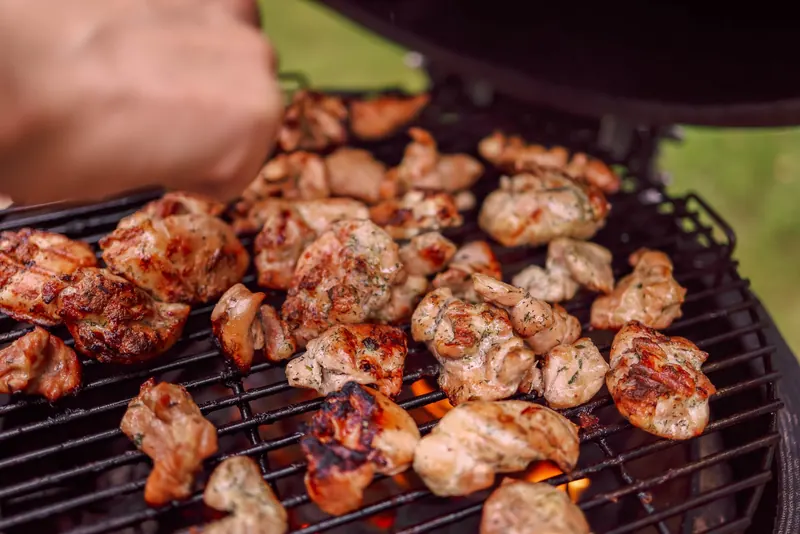
A kamado is a thick ceramic cooker that holds heat brilliantly once it is up to temperature. That makes it superb for long smokes and very hot pizza, but it behaves differently from a steel kettle: it is slow to cool, so overshooting a target is the most common beginner mistake. This guide covers lighting, vent settings for common temperatures, cooking set-ups and shutting down. Brands differ, so use your manual alongside it.
How airflow controls the heat
A kamado has a bottom vent below the firebox and a top vent in the dome. Air comes in at the bottom, feeds the lumpwood and leaves through the top with the smoke. More air means a hotter fire. Opening the bottom vent has the bigger effect; the top vent fine-tunes it.
Because the ceramic stores so much heat, the dome thermometer lags behind the fire. Once the ceramic is hot it takes a long time to drop, so approach your target slowly from below.
- Air in
- Heat rising
- Smoke out
Lighting a kamado, step by step
Most makers recommend good lumpwood charcoal and natural firelighters, not lighter fluid, because ceramic can absorb odours.
- 1
Clear old ash from the firebox and ash drawer so air can flow.
- 2
Fill the firebox with lumpwood, larger pieces at the bottom, up to about the fire ring for a long cook.
- 3
Push one or two natural firelighters into the top of the charcoal and light them; use one spot for low cooks, two or three for high heat.
- 4
Leave the lid open with the bottom vent open for about 10 minutes until the charcoal is well alight around the firelighters.
- 5
Fit the heat deflector if cooking indirect, then the grate.
- 6
Close the lid with both vents open and watch the dome thermometer.
- 7
Start closing both vents when you are within about 25 to 30 °C of your target, and make small adjustments after that.
Vent settings as a starting point
Every kamado, charcoal and day is different, so these are only rough starting points. Make small changes and wait 10 to 15 minutes to see the effect.
| Target | Uses | Bottom vent | Top vent |
|---|---|---|---|
| 110 to 135 °C | Pulled pork, ribs, brisket | Open a finger-width | Barely open |
| 160 to 190 °C | Chicken, roasts | Open about a quarter | Partly open |
| 200 to 230 °C | Hotter roasting, wings | Open about half | Half to fully open |
| 250 °C and above | Pizza, searing | Wide open | Wide open |
Direct, indirect and safe opening
For burgers and steaks, cook directly over the fire with no deflector. For roasts and smoking, put a heat deflector under the grate so the food is shielded from the fire, with a drip tray on the deflector. Half deflectors give a two-zone set-up; see two-zone cooking.
When a kamado is hot, opening the lid suddenly lets in a rush of air that can make a flare of flame shoot out, often called flashback or backdraft. Burp the lid: lift it an inch or two for a few seconds to let air in gently, then open it fully, keeping your face and arms clear.
Note:Use a kamado outdoors only, on a stable, level stand with locked wheels, away from fences and sheds. Burp the lid before opening at high temperatures and wear heat-resistant gloves. The ceramic stays hot for hours after cooking.
Shutting down and saving charcoal
When you finish, close the top and bottom vents completely. Without air, the fire goes out, and the unburnt lumpwood can be relit next time after you stir out the ash. The kamado will stay hot for hours, so leave it closed and do not cover or move it until cold.
Check food with a probe rather than time. The Food Standards Agency advises cooking poultry, pork and minced meat until steaming hot throughout with no pink meat; see our core temperature table. If you are still choosing a smoker or grill, compare best charcoal smokers and best charcoal BBQs.
Frequently asked questions
How do I lower the temperature on a kamado? Close the bottom vent a little, then the top, and wait. It drops slowly, so it is easier to approach a target from below than to bring it down.
How long does a kamado take to heat up? For low cooks, around 20 to 30 minutes; for pizza temperatures, longer, as the ceramic has to soak up heat.
Can I use briquettes in a kamado? Makers generally recommend lumpwood, which leaves less ash and fewer odours; see lumpwood or briquettes.
Why does my kamado keep overshooting? The vents were left open too long. Start closing them earlier, about 25 to 30 °C below your target.
What you need
- Check price on AmazonAffiliate link
Weber Smokey Mountain 14.5 in: compact bullet smoker
- Check price on AmazonAffiliate link
Weber Original Kettle 57 cm: One-Touch ash catcher