How-to
How to set up two-zone cooking on any BBQ
Published
Note: This page contains affiliate links. If you buy through them we may earn a commission at no extra cost to you. Learn more
In short
Two-zone cooking means one side of the grill is hot, directly over the fire or lit burners, and the other side has no heat underneath. On a kettle, bank the coals on one side. On a gas grill, light one or two burners and leave the rest off or low. On a kamado, use a half heat deflector. Sear over the hot zone, then move food to the cool zone and close the lid to cook through.
Products for this job
Compare all 7 productsWeber Original Kettle 57 cm: One-Touch ash catcher
Check price on AmazonAffiliate linkWeber Master-Touch GBS E-5750: hinged GBS grate
Check price on AmazonAffiliate linkWeber Performer Premium GBS: kettle on a work table
Check price on AmazonAffiliate link
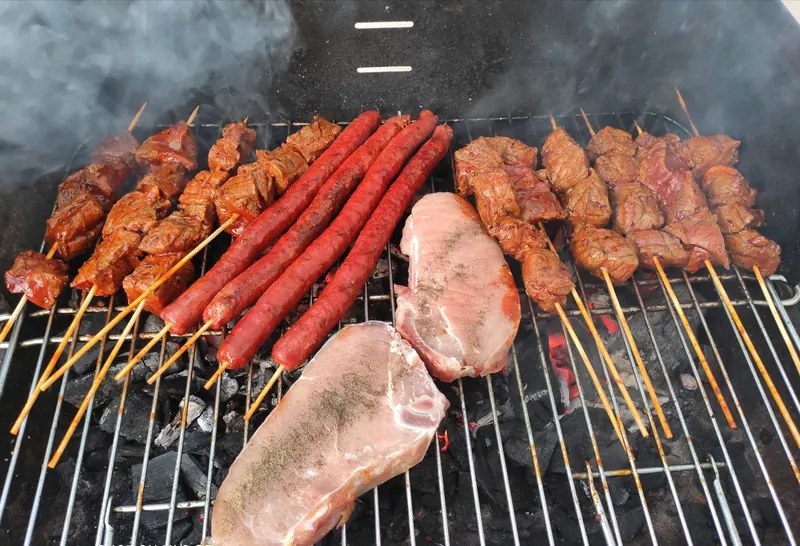
Burnt sausages that are pink in the middle are the classic barbecue failure, and the cure is the same on every grill. Instead of cooking everything directly over a full bed of heat, you create a hot zone and a cool zone. Food browns over the heat and finishes gently over the cool side with the lid closed, like an oven. This guide shows how to set it up on charcoal, gas and kamado grills and how to use it.
Direct and indirect heat explained
Direct heat is cooking straight over the coals or lit burners. It is fierce and fast, ideal for searing steaks, browning burgers and charring vegetables. Indirect heat is cooking beside the heat, not over it, with the lid closed. Hot air circulates around the food like a fan oven, which cooks thicker food through without burning the outside.
Most barbecue food benefits from both: a few minutes direct to colour it, then indirect to finish. Thin items such as burgers and prawns can cook fully direct; chicken pieces, thick sausages, pork chops and joints need the cool zone.
Kettle
Three-burner gas
Kamado
- Hot, direct zone and heat flow
- Cool, indirect zone
With the lid closed, hot air rolls from the direct side over the food on the indirect side and out through the top vent.
On a charcoal kettle
Light a chimney of charcoal as in how to light a charcoal BBQ. Pour the lit coals onto one half of the charcoal grate and leave the other half empty. Charcoal baskets or rails, included with some models such as the Weber Performer Premium GBS, help keep the coals in place.
Put the cooking grate on with any hinged section over the coals so you can add fuel later. Position the lid vent over the cool side, which draws heat and smoke across the food. Use the bottom vents to control the overall heat.
- 1
Light the coals and pour them onto one side of the grate.
- 2
Fit the cooking grate and preheat with the lid closed for 10 minutes.
- 3
Turn the lid so its vent sits over the cool side.
- 4
Sear food over the coals, then move it to the cool side.
- 5
Close the lid and cook until done, checking with a probe thermometer.
On a gas grill
Gas makes two-zone cooking easy. On a three-burner grill, light all burners and preheat on high, then turn one side burner off or to low. On a two-burner grill, run one burner high and one off or low. For a whole chicken or a joint, run the outer burners on medium and leave the centre off, cooking in the middle.
A one-burner grill such as a Weber Q cannot make a true cool zone, but a roasting trivet or tray raises food away from the direct heat, and cooking with the lid closed at a lower setting helps. Grills with three or more separately controlled burners are the easiest; compare them in best gas BBQs for UK gardens.
On a kamado
On a kamado the fire sits in a firebox below the grate, so you split the heat with a deflector. Kamado Joe's Divide and Conquer system uses half-moon deflectors; on other kamados, a half-moon stone or a deflector placed under one side of the grate does the same. Food over the deflector cooks indirectly; food over the open half gets direct heat.
For fully indirect cooks such as pulled pork, use a full deflector under the whole grate. Our how to use a kamado guide covers vent settings for each temperature.
- Air in
- Heat rising
- Smoke out
Using the zones and checking doneness
Start thicker items early on the cool side, then finish them over the heat for colour, or sear first and move them across; both work. Keep cooked food at the far edge of the cool zone to stay warm while the next batch cooks. If fat drips cause flare-ups, move food to the cool side until the flames settle.
Do not rely on colour. The Food Standards Agency advises cooking burgers, sausages, chicken and pork until steaming hot throughout, with no pink meat and juices running clear. With a probe, it lists 70 °C at the centre for 2 minutes, or equivalents; see our core temperature table. Whole steaks and lamb joints can be served pink if the outside is properly cooked.
Note:Keep raw and cooked meat apart, with separate tongs and plates. Use the grill outdoors, and keep children back from the hot zone.
Frequently asked questions
What is two-zone cooking on a BBQ? A set-up with one hot side and one cool side, so you can sear over heat and finish food gently with the lid closed.
Do I need a lid for two-zone cooking? Yes for the indirect side. Without a lid, food over the cool zone barely cooks.
Can I do two-zone cooking on a small BBQ? Yes on a small kettle by banking the coals; it is harder on a one-burner gas grill without a cool area.
Where should the lid vent be? Over the cool side on a kettle, so heat and smoke are drawn across the food.
What you need
- Check price on AmazonAffiliate link
Weber Original Kettle 57 cm: One-Touch ash catcher
- Check price on AmazonAffiliate link
Weber Spirit E-310: three burners, 2,326 cm² grill
- Check price on AmazonAffiliate link
Master-Touch Premium E-5770: stainless GBS grate
From: Weber kettle models compared: Original, Master-Touch and Performer