Guide
Can you use a BBQ under a gazebo or cover?
Published
Note: This page contains affiliate links. If you buy through them we may earn a commission at no extra cost to you. Learn more
In short
Generally no for fabric gazebos, garages, porches and anywhere enclosed. BBQ manuals require use in the open air with set clearances from anything that can burn, both above and around the grill. Charcoal, gas and pellet grills all give off carbon monoxide and heat that a roof traps. A tall, open-sided, non-combustible shelter may be acceptable only if it meets the clearances in your manual.
Products for this job
Compare all 6 productsWeber Spirit E-310: three burners, 2,326 cm² grill
Check price on AmazonAffiliate linkWeber Spirit E-425 Mix Griddle: four burners plus griddle
Check price on AmazonAffiliate linkNapoleon Freestyle 4: four burners, 13.6 kW
Check price on AmazonAffiliate link
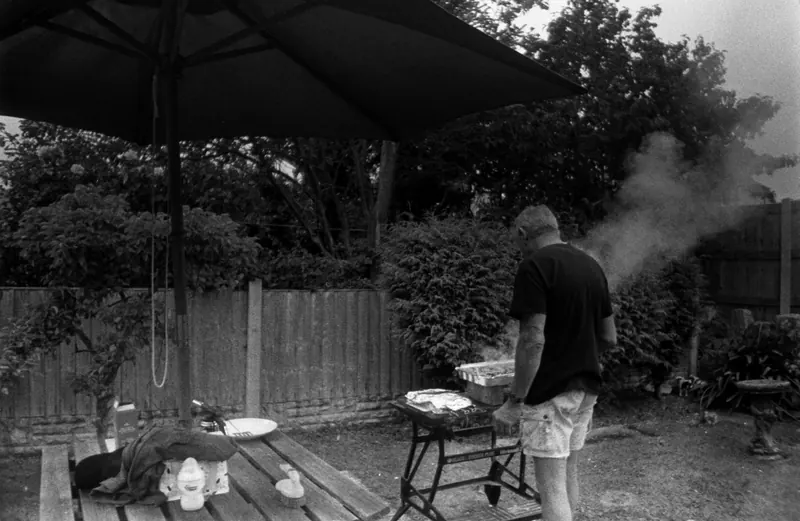
British weather makes this a very common question: it is raining, the food is ready and the gazebo is right there. The answer depends on the type of cover, how open it is and what your BBQ's manual says. This guide explains the two risks, fire and carbon monoxide, what manuals typically require, and safer ways to keep cooking when it rains.
The two risks: fire and carbon monoxide
Heat rises from a barbecue in a column. Under a low roof, that hot air and the occasional flare-up reach the canopy. Fabric gazebos, parasols, timber pergolas, plastic roofs and overhanging branches can scorch, melt or catch fire. Grease fires make this far worse, because flames can rise well above the lid.
All fuel-burning grills produce carbon monoxide, a gas you cannot see or smell. In the open air it disperses. In a garage, tent, porch, caravan awning or a gazebo with sides down, it can build up to dangerous levels. Charcoal is a well-known risk because it keeps giving off carbon monoxide long after cooking has finished, even when the coals look nearly out.
Note:Never use or leave a charcoal, gas or pellet BBQ inside a tent, garage, shed, conservatory, porch, caravan or awning, or a gazebo with the sides closed, even to cool down. If anyone feels headache, dizziness, sickness or drowsiness near a barbecue, move them into fresh air and get medical help.
What BBQ manuals usually say
Makers' manuals are clear that their grills are for outdoor use only and give minimum clearances from combustible materials at the sides, back and above the grill. The exact distances vary by model and type, which is why your own manual is the reference, not a general rule. Many also say not to use the grill under an overhead combustible surface or unprotected roof.
Some makers sell and approve specific outdoor kitchen set-ups or built-in installations with tested clearances and ventilation. A generic gazebo from a garden centre is not one of those. If you plan a permanent covered cooking area, ask the grill maker or a qualified installer.
Gazebos, pergolas and shelters compared
Not all covers carry the same risk. This table gives a general picture; your manual's clearances decide.
| Cover | General verdict |
|---|---|
| Fabric pop-up gazebo | Not suitable: low, combustible canopy that traps heat and fumes |
| Parasol or awning | Not suitable above the grill |
| Timber pergola with open roof slats | Only if manual clearances are met and airflow is free |
| Solid-roofed garden shelter, open sides | Possibly, if tall, non-combustible and clearances are met |
| Garage, shed, porch, conservatory | Never |
Electric grills and covers
Electric outdoor grills do not burn fuel, so they do not produce carbon monoxide from combustion, but they still get hot and still smoke from fat and food. Their manuals also specify outdoor use and clearances, and some ask you to keep them away from rain or to use a weatherproof socket. A Ninja Woodfire, for example, burns wood pellets for flavour, which adds smoke. See can you use a Ninja Woodfire indoors.
If you live in a flat with a covered balcony, check your lease and building rules first; many ban barbecues entirely. Where allowed, an electric grill is the usual choice. Our best electric BBQs for balconies guide compares them.
Cooking in the rain safely
The simplest approach is a grill with a good lid. A lidded gas grill or kettle cooks perfectly well in the rain with the lid closed, and the lid protects the food. Wear a hat, use a heat-resistant glove and keep tongs to hand so you spend less time outside.
Some cooks keep a large outdoor umbrella well to one side of the grill, not over it, to stand under. Gas grills with strong burners recover heat faster in cold, wet weather; propane copes better than butane. Compare lidded options in best gas BBQs for UK gardens and best charcoal BBQs.
Frequently asked questions
Can I use a gas BBQ under a pop-up gazebo? It is not advisable. The canopy is low and combustible, and gas grills produce heat and fumes that it traps. Follow the clearances in your manual.
Is it safe to bring a charcoal BBQ into a tent to warm it up? No. Charcoal gives off carbon monoxide for hours, even when cooling. Keep it outside, well away from the tent.
Can I barbecue under a carport? Only if your manual's clearances are met and the space is fully open with free airflow. A carport attached to the house is a poor choice.
What is the safest BBQ for a covered area? An electric grill used as its manual allows, with clearances respected. Fuel-burning grills belong in the open air.
What you need
- Check price on AmazonAffiliate link
Weber Spirit E-310: three burners, 2,326 cm² grill
- Check price on AmazonAffiliate link
Weber Lumin: 2,300 W, 33 x 49 cm, over 315 °C
- Check price on AmazonAffiliate link
Weber Original Kettle 57 cm: One-Touch ash catcher