Guide
How long does a BBQ gas bottle last?
Published
Note: This page contains affiliate links. If you buy through them we may earn a commission at no extra cost to you. Learn more
In short
Multiply the gas weight in kg by about 12.9 kWh for propane or 12.7 kWh for butane, then divide by your BBQ's total burner rating in kW. That gives hours at full power. A 13 kg propane bottle holds about 168 kWh, so it runs a 10 kW three-burner grill flat out for about 17 hours, and much longer on lower settings.
Products for this job
Compare all 6 productsWeber Spirit E-310: three burners, 2,326 cm² grill
Check price on AmazonAffiliate linkWeber Spirit E-425 Mix Griddle: four burners plus griddle
Check price on AmazonAffiliate linkNapoleon Freestyle 4: four burners, 13.6 kW
Check price on AmazonAffiliate link
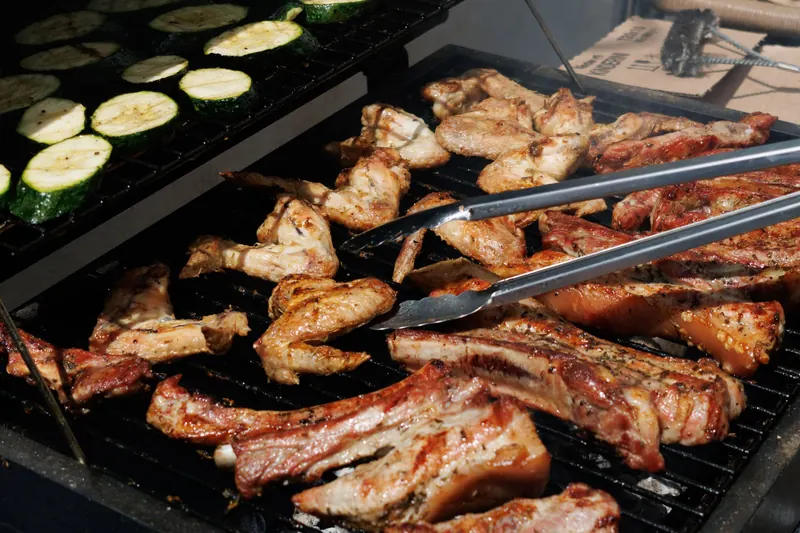
Running out of gas halfway through a party is avoidable with a little maths. Every bottle holds a known amount of energy, and every gas BBQ has a burner rating in kW. Dividing one by the other tells you the hours of cooking at full power. This guide explains the sum, gives a ready table for common UK bottles and grills, and covers what makes real use different.
The simple formula
LPG has a known energy content per kilogram. Using net calorific values, propane holds about 46.3 MJ per kg, which is about 12.9 kWh per kg, and butane about 12.7 kWh per kg. The weight on the bottle is the weight of gas, so the energy in a full bottle is easy to work out.
Your BBQ's total power is on the data plate, in the manual or in the listing, usually in kW. Add up the main burners, plus any side or sear burner you use. Then: hours at full power = (kg of gas x kWh per kg) / total kW. Our gas bottle burn time calculator does this for you.
- 1
Find the gas type and weight on the bottle, for example 13 kg propane.
- 2
Multiply by 12.9 for propane or 12.7 for butane: 13 x 12.9 = 167.7 kWh.
- 3
Find the BBQ's total burner rating, for example 8.2 kW for a four-burner Weber Spirit.
- 4
Divide: 167.7 / 8.2 = about 20.5 hours at full power.
Worked table for common bottles and grills
The table uses three real burner ratings from our guides: 2.93 kW (Weber Q 1200N), 8.2 kW (Weber Spirit EP-425) and 14 kW (Weber Genesis E-415). Figures are hours with every burner on full, rounded to one decimal place.
Propane
screw-on regulator
Typical sizes: 3.9, 5, 6, 13 and 19 kg
Butane
clip-on regulator
Typical sizes: 4.5, 7 and 15 kg
Patio gas (propane)
clip-on regulator
Typical sizes: 5 and 13 kg
Typical UK bottle colours and sizes; always fit the regulator made for your bottle and gas.
| Bottle | Energy | 2.93 kW grill | 8.2 kW grill | 14 kW grill |
|---|---|---|---|---|
| 5 kg propane | 64.5 kWh | 22.0 h | 7.9 h | 4.6 h |
| 6 kg propane | 77.4 kWh | 26.4 h | 9.4 h | 5.5 h |
| 13 kg propane | 167.7 kWh | 57.2 h | 20.5 h | 12.0 h |
| 7 kg butane | 88.9 kWh | 30.3 h | 10.8 h | 6.4 h |
| 15 kg butane | 190.5 kWh | 65.0 h | 23.2 h | 13.6 h |
Why real cooks last longer
Nobody runs every burner on full for a whole cook. You preheat on high for 10 to 15 minutes, then turn some burners down or off for two-zone cooking. Indirect roasting and smoking often use one burner on low. In practice a bottle usually lasts noticeably longer than the full-power figure, so treat the table as the worst case.
Some things shorten it: cooking with the lid open, strong wind, cold weather and very large grills used for small amounts of food. A side burner or sear burner on high adds its kW to the total while it runs.
Checking how much gas is left
The simplest check is to lift the bottle; with practice you learn what nearly empty feels like. Some people weigh the bottle on bathroom scales and subtract the empty weight stamped on the collar, which gives the kg of gas left to put into the formula. Clip-on gauges are also sold.
On a long cook, frost forming on a bottle shows gas being drawn off quickly; with butane in cool weather this can reduce the flow before the bottle is empty. A spare bottle, stored safely outdoors, is the easy insurance for parties.
Note:Change bottles only with all burners and the bottle valve off, and check the regulator joint with soapy water before relighting. Store spare bottles upright, outdoors and ventilated, away from drains and cellars, never indoors.
Choosing a grill with gas use in mind
A bigger grill is not always thirstier in use, because you can turn burners off. But a compact grill used for two people will stretch a bottle much further than a six-burner grill. If you mostly cook for a couple, a Weber Q or similar compact grill makes sense; see best small gas BBQs for a patio.
For family cooking, a three or four burner grill with separately controlled burners gives you the choice to use only what you need. Compare stated kW across models in best gas BBQs for UK gardens.
Frequently asked questions
How many BBQs will a 13 kg gas bottle do? It depends on grill size and cook length. On an 8.2 kW grill at full power it gives about 20 hours, so many family cooks of an hour or so, more on lower settings.
Does butane or propane last longer? Per kg they are almost the same, about 12.7 and 12.9 kWh. Propane works better in the cold.
Why does my bottle run out faster in winter? Cold weather and wind mean longer preheats and more time on high. Butane also vaporises poorly when cold.
Where do I find my BBQ's kW rating? On the data plate, in the manual or in the product listing; add the burners you use together.
What you need
- Check price on AmazonAffiliate link
Weber Spirit E-310: three burners, 2,326 cm² grill
- Check price on AmazonAffiliate link
Weber Spirit E-210: two burners, 51 x 46 cm grill
- Check price on AmazonAffiliate link
Weber Traveler: 63 x 34 cm grill on a folding trolley