Guide
BBQ cooking area explained: cm², grill diameter and burgers
Published
Note: This page contains affiliate links. If you buy through them we may earn a commission at no extra cost to you. Learn more
In short
Cooking area is the size of the grill surface, usually given in cm² in the UK or square inches for US-made grills (1 sq in = 6.45 cm²). Many figures add the warming rack to the main grate, so check the primary area. For round grills, area is about 0.785 x diameter squared: a 57 cm kettle has roughly 2,550 cm², a 47 cm kettle about 1,735 cm². Allow about 140 to 200 cm² per 10 cm burger.
Products for this job
Compare all 6 productsWeber Spirit E-310: three burners, 2,326 cm² grill
Check price on AmazonAffiliate linkWeber Spirit E-425 Mix Griddle: four burners plus griddle
Check price on AmazonAffiliate linkNapoleon Freestyle 4: four burners, 13.6 kW
Check price on AmazonAffiliate link
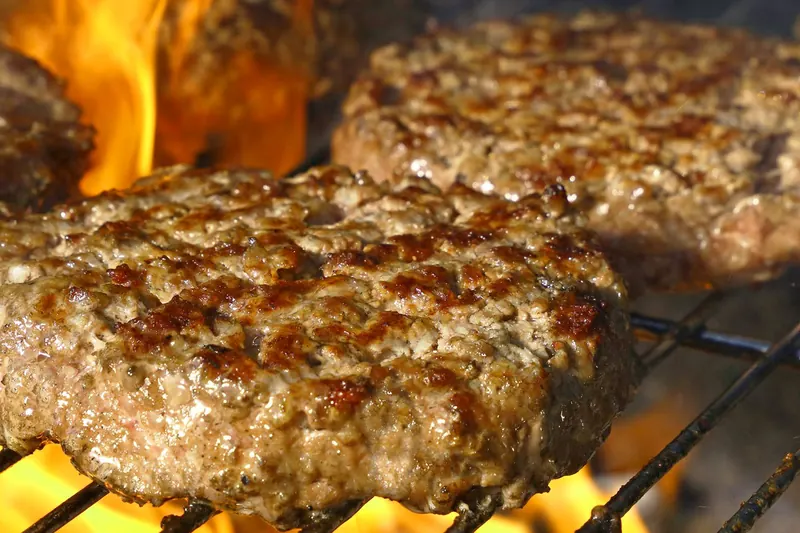
Cooking area is the one figure that tells you how many people a barbecue can feed, yet it is quoted in so many ways that comparing grills is hard. Some makers give the main grate, some add warming racks, and imported grills use square inches. This guide explains how to read the figures, how to convert them, what common grill sizes really hold, and how to use cooking area when choosing a BBQ.
Primary area and total area
The primary cooking area is the main grate directly over the heat. Total cooking area often adds warming racks, upper shelves or side burner grates. Both figures are useful, but only the primary area tells you how many burgers you can cook at once. A warming rack holds buns and cooked food, and it suits indirect cooking, but it is not where you sear.
The Kenmore 3-burner grill's listing shows the difference well: 512 sq in combined, of which 381 sq in is the primary surface and 131 sq in a warming rack. The Royal Gourmet offset smokers list 811 sq in in total, made up of 443 sq in of main grates, a 184 sq in warming rack and a 184 sq in firebox grate.
Converting square inches and grill diameters
To convert square inches to square centimetres, multiply by 6.45. To go the other way, divide by 6.45. For a round grate, area is pi x radius squared, or about 0.785 x diameter squared. Kettle and kamado sizes are usually given as the grate diameter in cm or inches.
Makers' own figures can differ slightly from the maths because the usable grate is a little smaller than the bowl. Weber lists 2,342 cm² for its 57 cm Original Kettle, close to the theoretical figure.
kettle
1,735 cm² (269 sq in)
about 16 burgers of 10 cm
kettle
2,552 cm² (396 sq in)
about 24 burgers of 10 cm
kettle
3,526 cm² (546 sq in)
about 33 burgers of 10 cm
kamado
1,662 cm² (258 sq in)
about 15 burgers of 10 cm
Circles drawn to scale. Area is π x radius²; burger counts are rough, with a little space between each.
| Grate diameter | Approx. area | Approx. 10 cm burgers |
|---|---|---|
| 37 cm (14.5 in) | About 1,075 cm² (167 sq in) | About 6 |
| 44.5 cm (17.5 in) | About 1,555 cm² (241 sq in) | About 8 to 10 |
| 47 cm (18.5 in) | About 1,735 cm² (269 sq in) | About 10 |
| 57 cm (22.5 in) | About 2,550 cm² (396 sq in) | About 13 to 15 |
| 67 cm (26.5 in) | About 3,526 cm² (546 sq in) | About 20 |
How many burgers per 1,000 cm²
A 10 cm burger covers about 80 cm², but you need space to slide the spatula in and turn it, and the edges of a grill are cooler. Makers' figures suggest about 140 to 200 cm² per burger: Weber says nine fit on the 1,290 cm² Q 1200N and 12 on the 57 x 41 cm Q 2200N. That works out at roughly five to seven burgers per 1,000 cm².
Sausages take less room each, chicken pieces and steaks more. For mixed food, plan by burgers and you will be close. Our food per person guide turns this into grill sizes for parties.
Rectangular grills: reading the figures
For gas and pellet grills, the grate is usually given as width x depth. Multiply them for the area: the Weber Traveler's 63 x 34 cm grate gives 2,142 cm² by maths, listed as 2,065 cm². The CosmoGrill Pro Deluxe's 77 x 42 cm grate gives about 3,234 cm², listed as 3,214 cm².
Watch for obvious errors in online listings, such as a large six-burner grill shown with 92 cm². When a figure looks wrong, use the stated grate dimensions or the maker's own spec sheet. Our guides mark these cases rather than guessing.
Using cooking area to choose a BBQ
Pick a grill whose primary area lets you cook for about a third of your usual guests at once, and add a warming rack if you entertain. For two to four people, around 1,300 cm² is plenty; for a family of four to six with guests, aim for 2,000 to 2,500 cm²; for big parties, 3,000 cm² or more. Remember that bigger grills need more space and more fuel to heat.
Compare models by stated area in best gas BBQs for UK gardens, best charcoal BBQs and large gas BBQs for family parties.
Frequently asked questions
How many people does a 57 cm kettle feed? Weber says six to eight people for its 57 cm Original Kettle, cooking in a couple of batches.
Does cooking area include the warming rack? Often yes for total area. Look for the primary area figure, or check the grate dimensions.
How do I convert square inches to cm²? Multiply by 6.45. For example, 443 sq in is about 2,858 cm².
Is a bigger cooking area always better? No. A large grill takes longer to heat, uses more fuel and needs more space. Buy for your usual numbers, not the one big party a year.
What you need
- Check price on AmazonAffiliate link
Weber Spirit E-310: three burners, 2,326 cm² grill
- Check price on AmazonAffiliate link
Weber Original Kettle 57 cm: One-Touch ash catcher
- Check price on AmazonAffiliate link
Weber Genesis II E-310 GBS: 3,456 cm² plus side burner